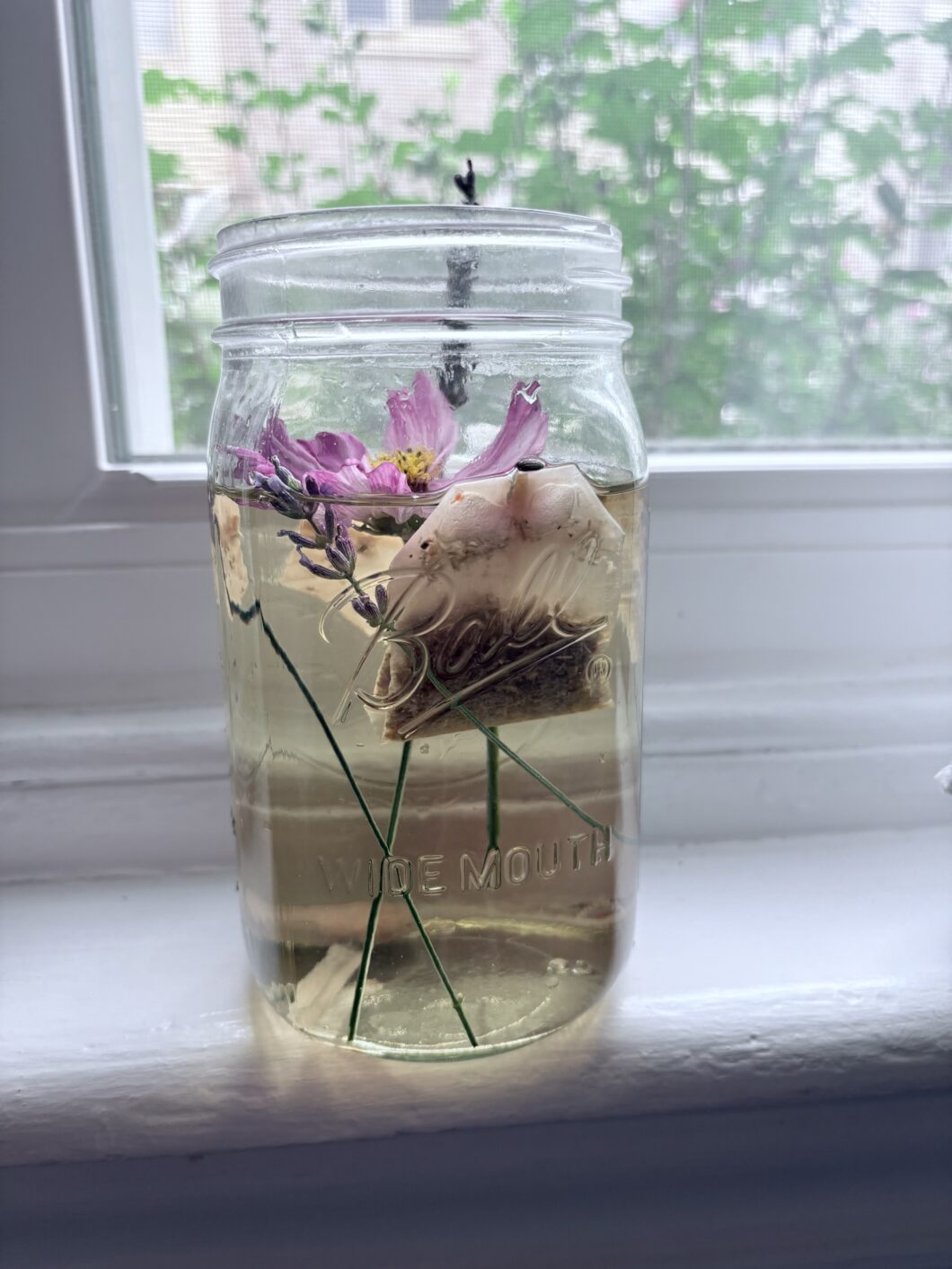
Full Moon Tea is simply an herbal tea left to percolate during the night under the light of the moon. Lunar infusions make for a beautiful full moon ritual—a moment to pause, reflect on the month that has passed, and set your intentions for the month ahead.
The full moon offers us a natural rhythm for reflection. Each month can be a beautiful opportunity to slow down, look back on the experiences that have shaped you, and gather the threads of your life.
Suggested ingredients for making a “lunar infusion”
If you don’t have these herbs on hand, you can substitute any loose herbs of your choice (either dry or fresh), or a teabag of herbal tea.
Chamomile (Matricaria recutita): Supports gut health, reduces inflammation, acts as a mild sedative, and promotes wound healing (great topically for some skin conditions). Subtle/spiritual effects: calms irritability and brings emotional stability.
English Lavender (Lavandula angustifolia): Supports the nervous system, reduces anxiety, lifts moods, acts as a mild sedative, relieves gastrointestinal gas, and has spasmolytic properties. Energetics: bitter, drying, cooling. Subtle/spiritual effects: relaxation, calm, and deeper meditation.
Red clover (Trifolium pratense): Traditionally used as a blood purifier to aid elimination of toxins, support skin healing, and relieve coughs and colds. It is rich in flavonoids and phenolic compounds, has antioxidant and anti-inflammatory properties, and is mineral-rich with mild estrogenic activity. Subtle/spiritual effects: helps to make sense of and understand your emotions, facilitates letting go, allows you to enter the dream state more easily, and supports deeper meditation.
Rosemary (Rosmarinus officinalis): Supports liver detox pathways, acts as an antioxidant, carminative, spasmolytic, and antimicrobial; promotes healthy circulation and increases mental alertness and memory. Subtle/spiritual effects: clarity, psychic protection, and a strengthened relationship with spirit.
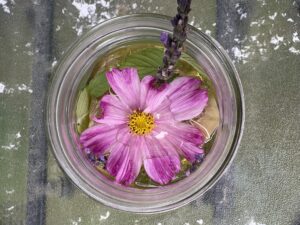
Edible flowers: Add edible flowers to your lunar infusion for beauty, flavor, and a deeper connection to the natural world. Some flowers traditionally used in teas and culinary preparations include rose petals, calendula, nasturtium, violet, lavender, and chamomile. Choose flowers that are specifically grown for culinary use and have not been treated with pesticides or chemicals.
Rocks, shells, and crystals: Add a natural object that holds meaning for you like a stone collected on a walk, a shell from the ocean, or a favorite crystal. These objects can serve as touchstones for reflection, grounding, and connection with the earth.
Instructions
- Select the herbs of your choice and place them in a clean glass jar. (Recommended: 1 tablespoon of herbs per cup of water.) If you’d like, add a favorite stone for grounding, a shell, or crystal.
- Pour room-temperature or slightly warm water over the herbs and place your jar on a windowsill, balcony, or outside in the full moonlight.
- Place the jar somewhere that will catch as much moonlight as possible.
- Set your intentions for this full moon: What do you wish for yourself, your family, your community, and the world over the next 30 days? Keep those intentions in your mind as you hold the infusion in your hands.
- Remember that other members of the human family are placing their moon tea out tonight—people around the world pausing beneath the same moon, reflecting on their own lives, hopes, challenges, and dreams. Send your community your good wishes and love as you gaze up at the moon.
- Tomorrow morning, strain the herbs using a cheesecloth or strainer, and compost them in the garden or somewhere outside your home to give their energy back to the earth.
Sip the tea, keeping your monthly (or beyond!) intentions in your mind. You can sip this tea throughout the next 24 hours.
A Full Moon Writing Practice
As you sip your tea, take a few minutes to write. Allow this monthly ritual to become a space for reflection; a time to gather the experiences, questions, and patterns that are shaping your life.
You might begin with these prompts:
What has changed since the last full moon?
What moments, conversations, challenges, or discoveries have shaped this past month? What do they reveal about where you are right now?
What patterns or themes are emerging?
What experiences keep returning? What questions are asking for deeper attention? Is there anything that’s become clearer?
When you look back to this same moon a year ago, what feels different?
As people around the world look up at the same moon, what do you want to remember about your place within your family, your community, and the wider human family? How is your story connected to the larger human story?
The moon moves through its cycles, and so do we. Each full moon offers another opportunity to pause, reflect, and honor the ongoing story of our lives.
Somewhere beneath that same moon, someone else is beginning again, asking their own questions, carrying their own hopes.
We are all part of this turning.