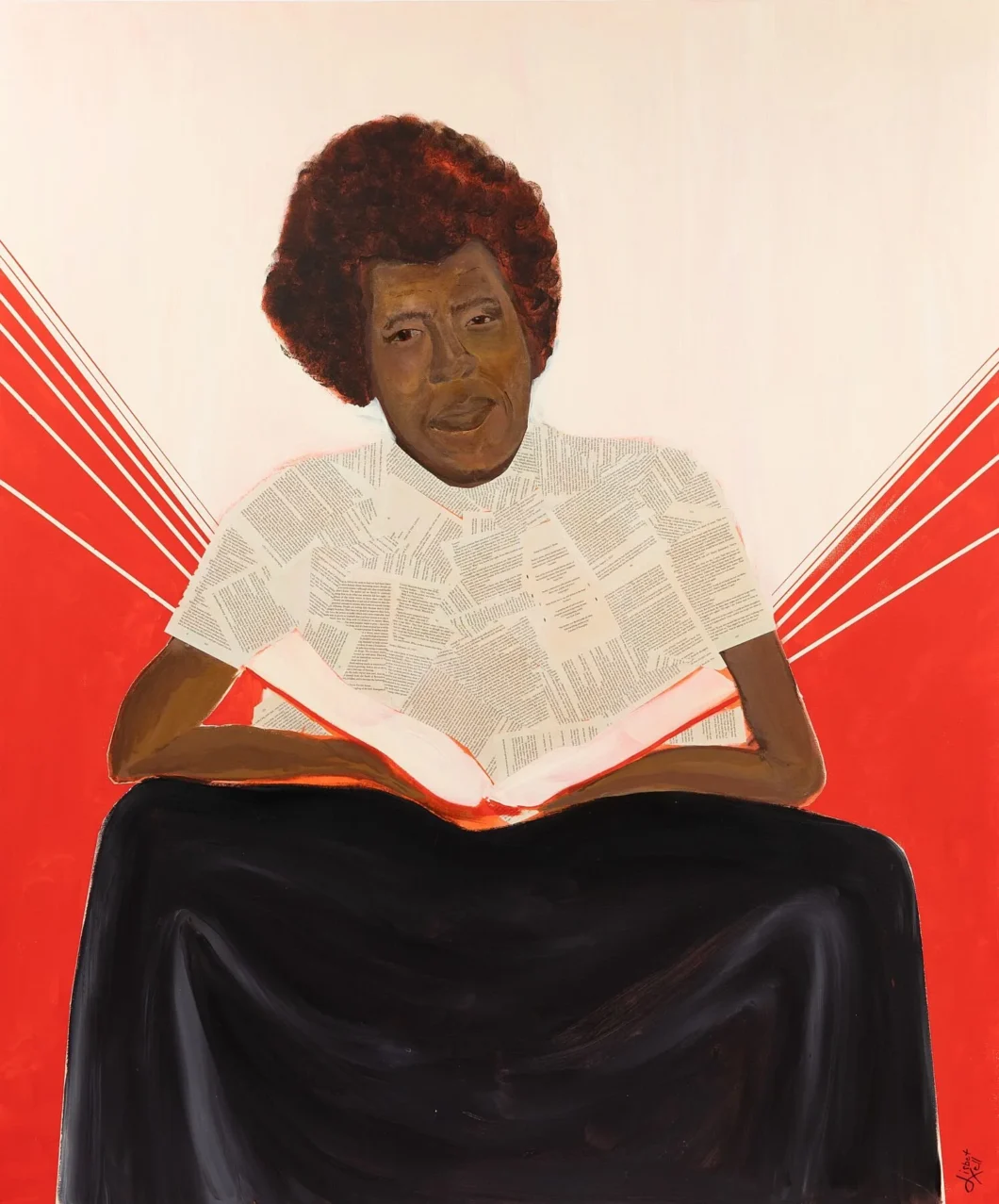
In her notebooks, a young girl wrote herself a command:
“I will be a bestselling writer.”
Imagine the child who wrote this: painfully shy, poor, dyslexic, far taller than her classmates, growing up in Pasadena with a widowed mother who cleaned houses. Teachers told her she was slow. She absorbed the message that the world was not arranged with her in mind.
Octavia spent long afternoons in the library. She read science fiction and noticed something quietly devastating: no one who looked like her was saving humanity. The future, as written, had excluded her.
The turning point came one evening when, at age nine, she watched the 1954 B-movie Devil Girl from Mars. The story was so clumsy that Octavia thought, with a flash of irritation: “Geez, I can write a better story than that!”
If the future did not contain her, she would write one that did.
By the age of ten, she had discovered “companionship in words,” and she could often be found with a large notebook in hand, capturing stories whenever a quiet moment allowed.
In the years ahead, she would often wake at 2 or 3 a.m. to write, before leaving for work as a dishwasher, potato chip inspector, telemarketer, or warehouse worker. Then, at 29, after a series of rejections, Octavia E. Butler’s first novel was published.
“All that you touch / You Change.
All that you Change / Changes you.”
— Octavia Butler
Octavia Butler’s novels — most notably Kindred and the Parable series — reimagined survival, adaptation, and community under pressure. She understood that change is not optional. Adaptation can be art. In doing so, she became a defining voice in Afrofuturism, a movement that centers Black identity, history, and imagination in visions of the future — insisting that Black people are not absent from what is to come, but central to it.
What Octavia Butler’s life makes visible is this: the future is a narrative we participate in shaping. When the story feels too small, too narrow, too hemmed in, we can begin the quiet, radical act of revision.
Building your own future isn’t fantasy. It’s tending to possibility, one choice, one moment at a time.
“There is nothing new under the sun, but there are new suns.” —Octavia E. Butler
Discussion
Butler wrote that everything we touch, we change — and that change, in turn, changes us. Where in your own life have you resisted change, and what did that resistance cost you? Where have you embraced it, and what did it open up? Is there a version of your life you have not yet given yourself permission to write?