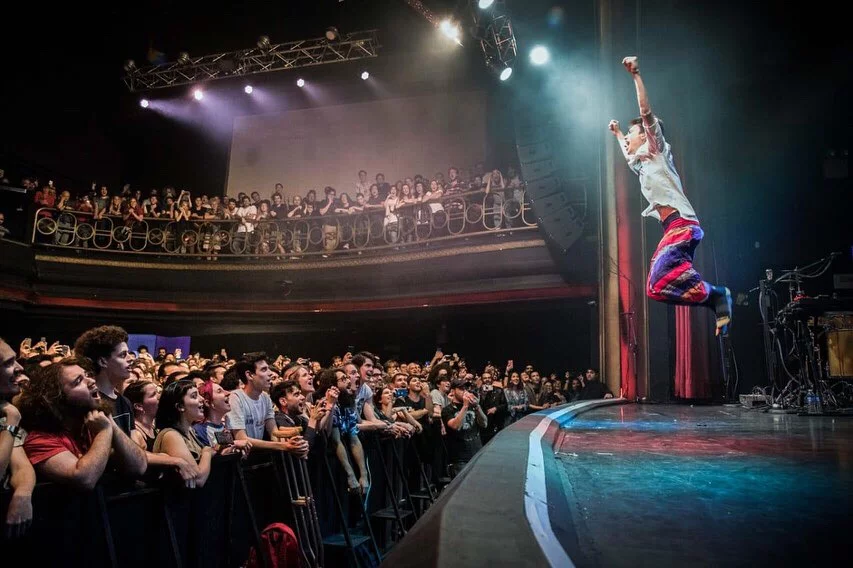
In October 2013, a nineteen-year-old boy in North London asked his mother whether she thought he should upload a video he’d been working on to YouTube. The video was a meticulously assembled split-screen arrangement of Stevie Wonder’s “Don’t You Worry ‘Bout a Thing” — one young man singing six vocal parts, beat-boxing, and playing more than a dozen instruments himself, each layer recorded separately and spliced together into something that shouldn’t have been possible for one person to make alone.
Jacob said to his mother, “I’m not sure I’m ready to give it away into the world.”
His mother replied that she thought Jacob’s video would really help people, but also, she had a feeling that if he did put it out there, nothing would ever be the same again.
She was right. Within hours, hundreds of thousands of people had viewed his video. Grammy-winning musicians passed it around in disbelief. Legendary Quincy Jones famously introduced Jacob to the industry by saying, “He is the future of everything I love about music.” Instead of trying to control Collier’s uniquely unconventional mixing and genre-bending styles, Jones encouraged him to “follow your goosebumps.”
Since uploading his video to YouTube in 2013, Jacob Collier has been dubbed the Mozart of Gen Z. He now tours the world with a full band, playing sold-out shows in arenas, concert halls, and music festivals across the globe. During his performances, he moves freely between jazz standards, chamber music, showtunes, and Coldplay.
But one of the most remarkable things that happens during Jacob’s performances is what happens in the audience.
At every concert, Jacob stands at the edge of the stage and conducts what he calls an “Audience Choir.” He assigns different sections of the theater different notes —leaping, grinning, raising and lowering vocal tones with a gesture of his hands — conducting the audience as though they’re an orchestra.
Ten, fifteen thousand people, untrained and unprepared, suddenly singing in gorgeous, glorious harmony.
Tears streaming down their faces in disbelief.
What Jacob Collier has created with his Audience Choirs has been referred to as “Communal Flow State” — a shared psychological state where a group of people become entirely immersed in a synchronized, collaborative activity. The individual’s self-consciousness melts away into a broader “we,” resulting in a unified group consciousness that people frequently describe as awe.
The brain responds to group singing the way it responds to some very specific things. Dopamine rushes in: the same neurotransmitter that fires when we eat a bar of chocolate or reach a goal we’ve been working toward. Endorphins follow, the body’s natural painkillers, the same chemicals behind a runner’s high. As oxytocin rises, stress hormones fall.
People in Collier’s Audience Choirs often weep. The feeling, by most accounts, is one of euphoria and calm arriving at the same time. The combined effect is something researchers describe as social bonding becoming measurable in the body.
What Jacob knows, and what fifteen thousand strangers discover in the middle of a song, has nothing to do with talent. He understands that creativity is our biological inheritance.
Your Turn
Creativity doesn’t belong to a special category of people.
It’s there when you write a letter you’ve been meaning to write, or make soup without a recipe. It’s there when you hum a little tune while you’re washing dishes, or rearrange a room to better take in the light.
This week, I have a little challenge for you: make something. Anything. Follow your curiosity somewhere unexpected and notice what it opens up when you do.
I believe this is what we’re here for — to experience the wonder of being alive in a body, and to keep making things with it for as long as we can.
Your life is a creative act.
Find out what it’s been trying to tell you.
Related Courses
Dear Friend: Free Letter-Writing Session
Tell Me Everything: A Four-Week Personal Essay Workshop